

Why We Argue
But we do agree on one thing.
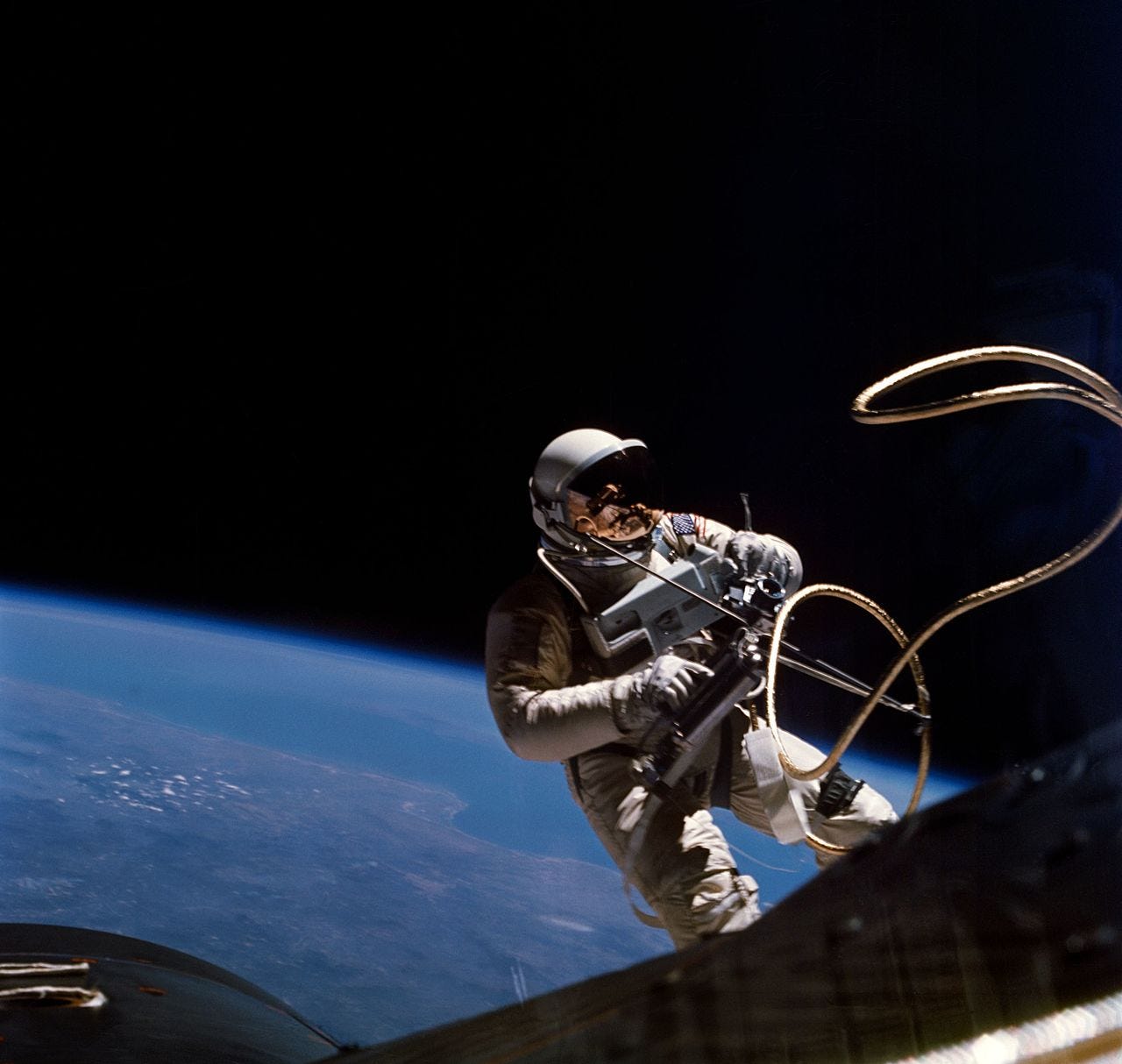
For many couples, arguments revolve around minor issues, such as money or a child’s education. For my partner and I, things get rocky when we argue over space exploration. Is it worth the price?
I’ve been a long-time fan. In elementary school, I was fascinated during a school assembly when a NASA spokesman frightened us by hurling a cup of smoking liquid nitrogen into the audience—but of course it evaporated instantly. Later, I faithfully watched every launch in the Gemini program, thrilling to the imagined thunder of rocket engines despite the tinny sound from our black-and-white TV set. During the Apollo missions, whenever NASA broadcast chat between astronauts and Mission Control, I recorded the audio on a reel-to-reel recorder so I could play it back and follow along in a simulator of the command module I’d constructed out of a big cardboard box. Star Trek was my favorite TV show; Arthur C. Clarke, my favorite author.
But I was disappointed to learn that my teenage height of 6’ 1” made me too tall to become an astronaut, the maximum allowed at that time being only six feet.
I gave up the dream of becoming an astronaut, but as I became an adult, I continued to follow the space program. Not just the manned efforts like Skylab and the Space Shuttle, but the unmanned ones, too. The Viking mission to Mars, the Magellan mission to Venus—it was hard to find detailed information and images of these back in the days before the Internet, but I got what I craved through Scientific American. I even had my own refractor and spent long nights peering up at the planets, dreaming of visiting them.
Once the moon missions ended, many in our country began to doubt the value of the space program. The questioning became more intense after the Challenger disaster and the end of the Cold War, which was the reason for the “space race” in the first place. But I always argued for the positive aspects. Not just for the spinoffs of technology like solar panels, memory foam and portable defibrillators, but also for the sheer joy of knowing that humanity was reaching out, exploring.
I still feel this way. Maybe someday we’ll discover dilithium crystals and invent the warp drive engine and seek out new worlds.
But my partner and I are at an impasse with irreconcilable differences. She thinks we should be spending our tax dollars on health care and education. “I just don’t get it,” she complained as we watched the splashdown of Artemis II. I replied that maybe we could funnel some of this year’s $892.6 billion defense budget or the billions we’ve spent on Trump’s War into helping and not killing people. Both of us agreed on that.
Despite our differences, we share the same desire deep down—to spend the money on humanity’s future. We really can have it both ways.